
Why Suffering Appears to Remain Present Even After Sleep

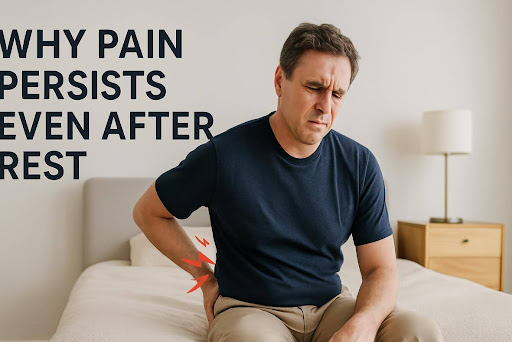
Sleep will do you good. That is what most people are advised when they are in pain. Slow down, take a break, sleep it off. That is a sound advice amid all sorts of pain and strains. Some pains, however, will not go away. You sleep, you take your rest, you do not tax your body, but next day, you are in pain.
Such frustration is common during this stage. Some of the questions being asked in people’s minds are whether they are imagining this or if they are doing something wrong. They are not. Often, it is common to have pain in this stage after resting. This can be a normal sign of a problem not being simple exhaustion and overwork.
A good start in effective pain management begins with an understanding of pain root cause.
Back pain starts when nerve signals are sent to your brain, which amplifies it because pain resulting from short-term strain leads to rest, muscles heal. Small inflammation vanishes. The body readjusts. Among the effects is permanent immobilization for acute pains or minor injuries.
A chronic pain will not behave in such a manner. You will not be able to resolve it simply by resting. Pre-existing inflammation, nerve hyperalgesia, mechanical dysfunction, or pain miscommunication can persist when you are not moving. The purpose of resting in such a case is to alleviate pressure.
In fact, this is why a few people will experience increased pain after prolonged inactivity. The body will stiffen. Blood will not flow. Muscles will become tight. The pain will be more evident.
Inflammation does not always go off
The healing process entails an inflammatory stage which takes a rather long time. After it becomes chronic, it ceases to be an indication of healing and progresses to become an irritation at all times.
The presence of low-grade inflammation can persist without a conspicuous wound. This can be a consequence of chronic stress, tissue damage left unresolved, or other predispositions. The need for rest does not abate it. Interruptions come from dynamics and focused therapies sometimes.
This pain feels to be tender, sore, or deep. Such pain can fluctuate from time to time but never leaves.
Sensitivity of nerve fibers affects pain perception
The nerves cause and perpetuate intractable pain. The excited nerve cell relays stronger impulses with normal stimuli. What was weak yesterday appears to be strong. It does not fade with rest.
This is also known as pain amplification. The nervous system is very alert and reactive. It does not quiet with rest. Pain can sound more prominent during quiet periods because there are fewer distractions.
The pain which is related to nerves might have a burning, tingling, shooting, and sore nature. Such pain is an indicator of nervous system involvement rather than simple muscular exhaustion.
No Sleep, You keep the Pain Alive
Most people think they are sleeping well if they are not. Sleeping a lot in a piece of paper can be considered superficial. Pain interferes with sleeping. Reducing sleep in a body reduces pain in a body.
The quality of sleep decreases, and a different pain processing centers in the brain. Tolerance for pain decreases. A prolonged time for muscle recovery. Elevated levels of stress hormones. The body also feels awake when it is underrested, even if a patient lays in bed.
It is because of this very reason that pain and sleep disorders will normally coexist. It will be less effective to address one.
A Self-Feedback loop exists between Stress and Pain
Stress not only affects an emotional state. Stress affects all elements of tension maintenance in the body, nerve impulses, and pain. The chronic stress state maintains both muscles and nerves in a state of partial tension.
Sleeping during a stressful time is not as effective as when you are not stressed. The body remains in a state of protection. The pain in the body continues to be relayed. With time, this stress gets habitual. The body will not be able to relax.
Therefore, this is why pain will improve with vacation time or with relief despite increased activity. It is only subsequent to this time that relief can occur because the nervous system can finally relax in order to release.
Occasionally, these mechanical issues will not work out on their own.
The body is compensating for a problem in mechanics, which is why pain of some sort is present. Poor posture, ambulation, joint imbalance, or old traumas that healed dysfunctionally are all part of it.
“Rest will not improve these numbers. They will be perpetuated, perhaps enhanced. Muscles will atrophy. Supportive components will weaken. Pain will recur with the onset of movement to be appreciated.”
The most effective way to deal with such a pain would be guided movement or physical therapy. Inactivity would not be advisable in such a case.
When Suffering is a Conditioned Reaction
Chronic pain affects pain predictions in a brain. The brain gets conditioned to expect pain. In addition, it conditions the body. Then, there is a contraction of muscles. The focus is placed on sense. Suffering gets easy to induce.
However, this does not mean that pain is not real. In this case, it means that the nervous system has developed to a state where it is no longer an asset to the body. Furthermore, resting will not help to recondition these bodies.
Therefore, education counts. Knowledge of pain reduces fear, and reduced fear reduces pain to many people.
When Rest No Longer the Solution
“Constant pain speaks to you with a message to re-evaluate. Do not push further. Do not ignore it for a longer time. Instead, look deeply into it.”
They make an assessment of pain through a series of questions such as these: What makes the pain worse? What gives relief? How it affects sleeping? Did it radiate? How long have you had this pain?
They can be used for dealing with the problem of inflammation, nerve sensitivity, or mechanical adjustment. In other cases, prescription assistance is offered when pain gets in a way of carrying out life.
Getting rid of pain, not immediately but making pain have less grip on your daily life and getting you functioning again.
What to Do When the Pain Does Not Go Away
Continue resting if not relieved, otherwise switch strategies.
- Observe Patterns, not a sense of fighting.
- Move slowly rather than moving not at all.
- Purposeful sleep enhancement.
- Manage Stress & Physiological Symptoms
- Speak with a medical professional concerning chronic pain.
- Ongoing pain is not a problem in you. Ongoing pain is information.
A Clear Next Step
As you undergo pain despite resting and taking simple steps for prevention, you may be curious to know how pain is evaluated in order for your next consultation with a physician to be more productive. Our Pain Wellness Guide talk about pain patterns, treatment methods, and what can be talked about when pain will not resolve on its own. In case pain is already affecting sleep, mobility, or function, a professional evaluation is necessary. Hurtful information can prevent problems from developing in the future. Suffering will not hang around to try your patience. Suffering will be present since there is always a deeper dimension to attend to.