
Generalized Anxiety Disorder (GAD): A Real-life Guide to Adults

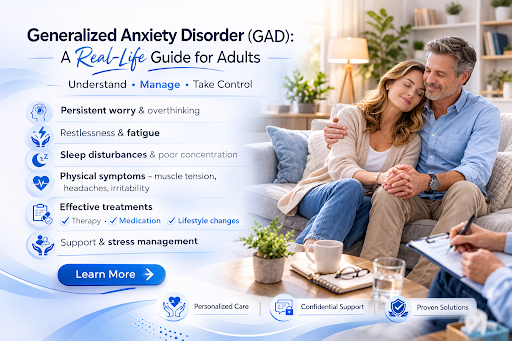
Generalized Anxiety Disorder (GAD) is one of the most frequent anxiety disorders, which a clinician encounters on a regular basis. It is something that many people carry out of their life long without knowing. He or she can claim being a worrier all his or her life or that his or her mind never switches off, without understanding that these are the symptoms of an identifiable and treatable condition.
I have already written some patient education in the medical and pharmacy profession and I would be straightforward, GAD is not a symptom of weakness, overreacting or defect of character. It is a health disorder that can be diagnosed, has definite patterns, causes, and interventions. This guide describes the GAD in a simple language with no jargon or hyperboleism, meant to be clear and simple-to-understand among the U.S. adults aged 35 to 80 that seek simple and clear answers.
What Is Generalized Anxiety Disorder?
Generalized Anxiety Disorder is a persistent level of anxiety disorder, which involves excessive worry about normal day-to-day issues even when there is no threat at hand.
Individuals who have GAD do not merely worry here and there. Their worry is:
- Frequent
- Hard to control
- Wide‑ranging
- Months or years long.
- Disproportionately.
GAD is characterized by clinical diagnostic criteria such as excessive anxiety and worry (on most days) over a period of at least six months with physical and mental symptoms.
This is not short‑term stress. It is chronic excessive stimulation of the nervous system.
How GAD Feels in Daily Life
The majority of patients with GAD report the experience in similar terms:
- I have a brain that is searching all the time.
- Something will go wrong, I suppose.
- Even trivial choices are cumbersome.
- I cannot relax, even in times when things are copacetic.
Common worry themes include:
- Health concerns
- Family safety
- Finances
- Work performance
- Aging issues
- Medical test results
- Future uncertainty
- Daily responsibilities
The issues might be different, but the anxious pattern remains unchanged.
GAD is more of a constant background hum of anxiety, as opposed to its sudden waves typical of panic disorder.
Mental Symptoms of GAD
The cognitive style of GAD is identifiable.
Common cognitive symptoms:
- Constant “what if” thinking
- Assuming the worst possible scenarios.
- Unable to tolerate uncertainty.
- Repeated mental checking
- Overanalyzing decisions
- Difficult to forget the concerns.
- Feeling mentally tense
- Difficulty concentrating
Most patients report that they have a busy mind on a still body.
Physical Symptoms of GAD
The GAD is not merely mental – it is physical. The body remains in a low-level fight-or-flight condition.
Typical physical signs:
- Tension of the muscles (neck, shoulders, jaw)
- Restlessness
- Fatigue
- Headaches
- Upset stomach
- Sweating
- Shaky feeling
- Sleep problems
- Fast heartbeat
- Shortness of breath feeling
All these are actual physiological reactions- not imagined. Anxiety in the long term maintains stress hormone levels.
Majority of patients report to a doctor with the physical symptoms and by the time they notice that they are driven by anxiety.
The Differences between GAD and normal worry
Everyone worries sometimes. Normal worry:
- Is contingent upon a situation.
- Has a clear cause
- Solve once the situation is gone.
- Not domineering day to day thought.
GAD worry:
- Appears across many topics
- Feels difficult to control
- Persists even after the issues are solved.
- disrupts normal operations.
- Causes constant physical tension.
The clinicians have a simple rule: when worry is excessive, persistent, and impairing it can be GAD.
What Is the Cause of Generalized Anxiety Disorder?
There is no single cause. GAD typically arises out of a number of overlapping factors.
- Biological factors
- Brain chemistry imbalance
- Hyper-Active Threat Response System.
- Stress hormone sensitivity
- Genetic predisposition
- Family history
Individuals possessing close kinship with persons with anxiety or mood disorders are at risk.
Chronic stress exposure
Caregiving in the long term, economic stress, disease, or work stress may alter the nervous system to the state of constant vigilance.
- Personality traits
- Perfectionism
- High responsibility
- Need for control
- Risk sensitivity
Medical contributors
- Thyroid disorders
- Chronic pain
- Heart rhythm issues
- Hormonal changes
- Sleep disorders
GAD is a tendency that frequently occurs when there is weakness and stress.
Age of Onset -It is not a Young Person Only Condition.
GAD can begin at any age. Common patterns:
- Other individuals complain of worry habits throughout life.
- Others acquire GAD in middle life when making stress transitions.
- It occurs to many after 50 years of age because of health, retirement or loss.
The elderly are usually poorly diagnosed as they are confused with normal aging stress.
They are not the same.
How Doctors Diagnose GAD
However, treatment is not a single lab test but a diagnosis based on clinical evaluation.
A medical professional will evaluate:
- Duration of worry
- The nature and the degree of anxiety.
- Physical symptoms
- Sleep patterns
- Functional impact
- Medical history
- Medication use
- Substance intake
- Rule‑out medical causes
Physicians tend to screen with structured criteria of the Diagnostic and Statistical Manual of Mental Disorders.
In case of need, lab tests can be requested to eliminate thyroid disease, vitamin deficiencies, or cardiac problems.
Other Disorders that Coexist with GAD
GAD does tend to overlap with other disorders.
Frequent symptoms:
- Depression
- Insomnia
- Chronic pain disorders
- Irritable bowel syndrome
- Panic disorder
- Social anxiety
- Substance misuse
Only one can be treated and the others neglected which causes an incomplete improvement.
- Good care considers the big picture.
- Evidence-Based Intervention Programs.
GAD is very treatable. Majority of the patients respond to good treatment.
These may be treated with one or more of the following:
Cognitive Behavioral Therapy (CBT)
CBT is a non-pharmacological intervention that is among the most effective interventions to treat GAD.
It teaches patients to:
- Identify worry patterns
- Buck against disastrous thinking.
- Reduce avoidance behaviors
- Learn to be tolerant of uncertainty.
- Develop calming skills
CBT is systematic, empirical and skill oriented. It is highly desirable to many patients since it provides them with long-term tools.
Medication Options
Medication can be suggested in case the symptoms are moderate to severe, or in case they are persistent.
Typical first-line drugs:
- SSRIs and SNRIs – these control serotonin and norepinephrine, reduce the baseline anxiety, are not addictive, and most likely require weeks to work.
Other options:
- Buspirone
- Some antihistamine agents.
- Chosen off-label interventions.
- Benzodiazepines
These are able to relax anxiety but should be taken cautiously since they can produce to the effect of sedation, dependence, tolerance or even causing more falls among the elderly. Benzodiazepines may not be effective as long-term medicine but only temporary.
A licensed clinician should always make decisions concerning medication.
The Style Of Living That Counts
Lifestyle modifications cannot be described as soft advice. They cause quantifiable effects upon the nervous system.
High‑impact habits include:
- Sleep control – maintain a regular sleep pattern and reduce evening stimulation and caffeine. A lot of patients do well when caffeine is reduced to less than 1-2 cups a day.
- Physical exercise – regular exercises help to balance stress hormones and relax muscle sphincter.
- Breathing and relaxation training – it decelerates the autonomic activation.
- Routine daily life – it reduces uncertainty.
- Social attachment – it reduces the biological stress reaction.
These practices are not to substitute treatment or medication in case these are required but they are a great advocate of recovery.
What GAD Is Not
The misconceptions should be explained. Generalized Anxiety Disorder (GAD) is not:
– An indication of insecurity or lack of discipline.
– Attention seeking or bad character.
– It is something that you can just stop doing.
– An unusual or untreatable disorder.
GAD is an issue of nervous-system regulation, which reacts to systematic treatment.
Professional Help: When is it Necessary?
Think about assessment when concerned:
– Happens most days for months
– Disrupts sleep
– Affects concentration
– Causes physical tension
– Impedes decision‑making
– Leads to avoidance
– Impacts relationships
– Reduces quality of life
Assessment can be initiated by the primary-care providers, and special attention can be given by mental-health specialists. Prevention of early care avoids suffering, which wastes years.
A Practical Closing Thought
Individuals affected by GAD are usually very responsible, considerate and diligent. The same characteristics may cause an overworking stress system.
Treatment is not aimed at eliminating vigilance or responsibility but to bring the nervous system to equilibrium. Most individuals with GAD have a meaningful long-term improvement with the correct mixture of therapy, usage of the right medication where necessary, and routines of managing the disorder on a daily basis.