Panic Attacks v/s Anxiety Attacks?

Several individuals confuse between a panic attack and an anxiety attack. In everyday talk that’s fine. In a medical context, though, they are used to mean other things.
It is important to know the difference particularly to the adults between the ages of 35 and 80. The causes, how the doctors treat them, and the tests they do may be varied. I have been assisting in drafting educational resources in pharmacies and clinics, and I have observed the fact that confusion is the biggest issue that people possess.
This is the guide to a plain, practical language, without a trace of medical jargon, exaggeration, or fear-mongering. It is in accordance with the norms applied by health-care providers in the United States.
Quick Summary
In the case you want the bite-size version:
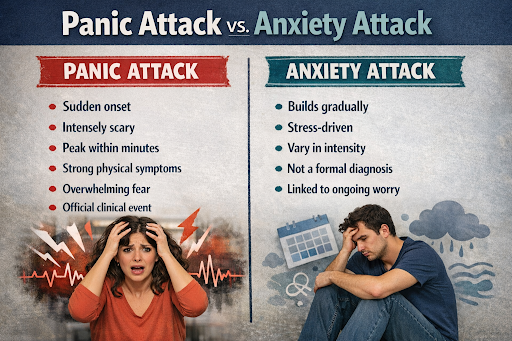
Panic attacks
- Sudden
- Intensely scary
- Peak in minutes
- Strong physical symptoms
- Experience overwhelming fear.
- Known as an official clinical event.
Anxiety attacks (common-speak).
- Build gradually
- Stress‑driven
- Vary in intensity
- Not a formal diagnosis
- Often tied to ongoing worry
And now a little further and you will see each.
What Is a Panic Attack?
A panic attack is an abrupt explosion of fear or discomfort that escalates rapidly- in most cases 5- 10 minutes. It switches on the emergency system of the body in times that there is no actual threat. It is characterized by professionals, such as those of the American psychiatric association, as a sudden and several physical and mental events simultaneously.
There are typical symptoms of a panic attack.
It feels physical when there is panic. At first many people believe that they are having a heart attack. Typical signs include:
- Rapid heart rate
- Chest tightness or pain
- Shortness of breath
- Dizziness
- Sweating
- Trembling
- Nausea
- Chills or hot flashes
- Tingling in hands or face
- Sensation of being out of the world.
- Fear of losing control
- Fear of dying
All the symptoms are not experienced by all, but a majority of the people experience a few of them simultaneously.
What Is the Duration of a Panic Attack?
Most panic attacks:
- Peak in about 10 minutes
- Improve within 20–30 minutes
- Make the individual feel exhausted after doing so.
In reality, they are brief but they seem considerably longer to the person who is going through them. The panic attacks are not physically dangerous, although they seem very threatening.
What Is an Anxiety Attack?
It is not the diagnosis of an anxiety attack. It is a term that is applied by people to define a time of increased anxiety. Physicians frequently take the meaning of it to be:
Anxiety or worry of such magnitude but not sufficient to warrant a full panic-attack. Compared to panic attacks, anxiety attacks tend to:
- Precipitated by a recognized stressor
- Build gradually
- Are less physically intense
- Last longer
- Are driven by thoughts
The symptoms that are referred to as an anxiety attack by people.
When an individual explains that he has an anxiety attack, he/she will tend to say:
- Rising worry
- Experiencing mental burnout.
- Muscle tension
- Restlessness
- Racing thoughts
- Irritability
- Trouble focusing
- Mild shortness of breath
- Mild chest tightness
- Feeling on edge
It is not a very comfortable experience, sometimes really uncomfortable, but not generally explosive, like a panic attack.
Sudden vs Gradual Onset Difference
This is among the best contrasts.
1.Panic attack
- Symptoms are sudden and usually out of the blue.
Hypothesis: You are sitting and within some minutes your heart is rushing and you feel that something is terribly wrong.
2. Anxiety attack
- Stress accumulates slowly with symptoms.
Illustration: You are concerned all day about the result of a medical test, and in the evening you are nervous, afraid, and intimidated.
3.Trigger Patterns
Panic attacks may be:
- Unexpected
Situational (flying, crowds, driving)
- Linked to panic disorder
- Connected to phobias
Anxiety attacks are usually:
- Stress‑triggered
- Situation‑linked
- Thought‑driven
- Worry‑based
Intensity Level Comparison
Imagine the intensity as a volume dial.
Panic attack = full at maximum.
- Strong body response
- Hard to ignore
- Disrupts activity
Volume increased = anxiety attack.
- Noticeable distress
- Still functional (often)
- Able to continue working or chatting.
The Physicality of Panic Attacks
Panic attacks activate the sympathetic nervous system -fight-or-flight response. That triggers:
- Adrenaline release
- Faster heartbeat
- Rapid breathing
- Muscle tightening
- Blood flow shifts
You are safeguarded with this system during a real emergency. During a panic attack it switches on regardless of whether there is actual danger, generating the disastrous disequilibrium.
Is It Possible to Have One Without the Other?
Yes.
Some people have:
- Acute anxiety attacks, but no chronic anxiety.
- Anxiety that is chronic, but without panic attacks.
- Both conditions together
A common panic disorder can be diagnosed with frequent panic attacks. Constant worry devoid of episodes can be generalized anxiety disorder. They are similar yet different.
Age Considerations (35‑80 Adults)
In middle-aged and elderly people, panic attacks will be misunderstood as:
- Heart problems
- Breathing disorders
- Medication reactions
It is essential to have a medical check-up, particularly when the episode is the first after the age of 40 in order to exclude the possibility of heart or metabolic causes. Anxiety causes are taken into account after the clearance. Do not suppose that chest symptoms are innocent without expert inspection.
General Medical Conditions that may resemble Panic.
Doctors usually rule out:
- Heart rhythm problems
- Thyroid disorders
- Asthma
- Blood sugar swings
- Medication side effects
- Stimulant reactions
National Institutes of Health emphasize the significance of medical screening of new or severe symptoms. This is a good practice- no overtesting.
After-Effects: The Fear of Fear Cycle
Following a panic attack, several individuals develop:
- Fear of another episode
- Shy places or activities.
- Excessive body monitoring
This is referred to as anticipatory anxiety. It may be reducing life, avoiding travel, stores or social outings, otherwise. Anxiety attacks on the other hand do not normally make one to avoid so much.
Interventions vary marginally.
Therapy has advantages in both conditions, although the emphasis is different.
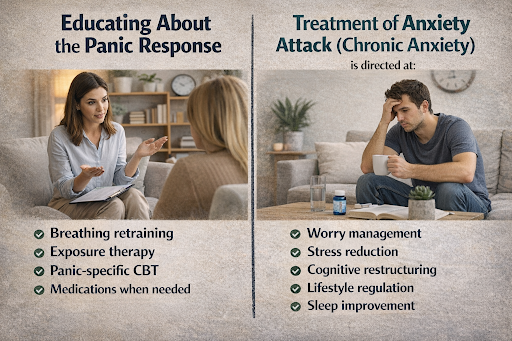
The treatment of panic attacks aims at:
Educating about the panic response.
- Breathing retraining
- Exposure therapy
- Panic‑specific CBT
- Medications when needed
Treatment of anxiety attack (chronic anxiety) is directed at:
- Worry management
- Stress reduction
- Cognitive restructuring
- Lifestyle regulation
- Sleep improvement
They both respond positively to organized therapy.
Medication Response
Several classes of medications can be used if the symptoms are frequent or disabling:
– SSRIs
– SNRIs
– Buspirone
– Medications with short term use, in select cases
Medication choice is based on pattern, frequency, age, other health conditions and risk factors.
There is no one size fits all drug solution.
When to Seek Medical Evaluation
Seek professional evaluation when episodes include:
– Chest pain
– Fainting
– New onset after age 40
– History of heart disease
– Severe shortness of breath
– Neurological symptoms
– Frequent recurrence
– Avoidance behavior
– Sleep disruption
– Functional impairment
A primary care visit is a good place to start. Mental health specialists can then implement specific treatment.
A Practical Reality Check
Both panic attacks and anxiety attacks are:
– Real
– Treatable
– Common
They are not symptoms of weakness and they are not permanent conditions. Most individuals improve considerably with the proper education and treatment plan. The worst error is ignoring the symptoms for years because of embarrassment or misunderstanding.
Bottom Line
Panic attacks are sudden, intense and physically overwhelming episodes that occur in clinical diagnosis.
Anxiety attacks are a popular phrase used to define stress-induced peaks in anxiety which escalate slowly and in varying intensities.
Knowing the difference helps to guide the right care and eliminate unnecessary fear.