
Science of Sleep Cycles: Deep sleep vs REM Sleep

Author: Dr. Daniel Carter, PharmD
Medically Reviewed by: Dr. Emily Harrison, MD (Internal Medicine)
Last Updated: March 2026
Introduction
Sleep is not a pure state of rest; it is a complicated biological process that comes in a number of phases. The brain also passes through several sleep stages during the night that facilitates physical healing, memory development, and emotional stability.
Scientists distinguish two main forms of sleep, namely Rapid Eye Movement (REM) sleep and Non-REM sleep that consists of deep sleep phases. These phases are repeated after every 90 minutes.
By learning the mechanisms of the sleep cycles, one can understand the reasons why both the REM sleep and deep sleep are vital in general health.
Overview of Sleep Cycles
Sleep cycle may consist of four stages:
- Stage 1 – Light sleep
- Stage 2 – Stabilizing sleep
- Stage 3 – Deep sleep
- REM sleep
The number of times that these cycles repeat is four to six times per night.
Stage 1: Light Sleep
Stage 1 refers to the process of waking up and falling asleep.
During this stage:
- Heart rate slows
- Breathing becomes steady
- Muscles relax
- The functioning of the brain starts to vary.
The duration of this phase is normally 5-10 min.
Stage 2: Stabilizing Sleep
Approximately half of the total sleep time is attributed to stage 2.
During this stage:
- Body temperature decreases
- Heart rate slows further
- The brain activity exhibits certain patterns referred to as sleep spindles -the patterns help in guarding sleep against external disruptions.
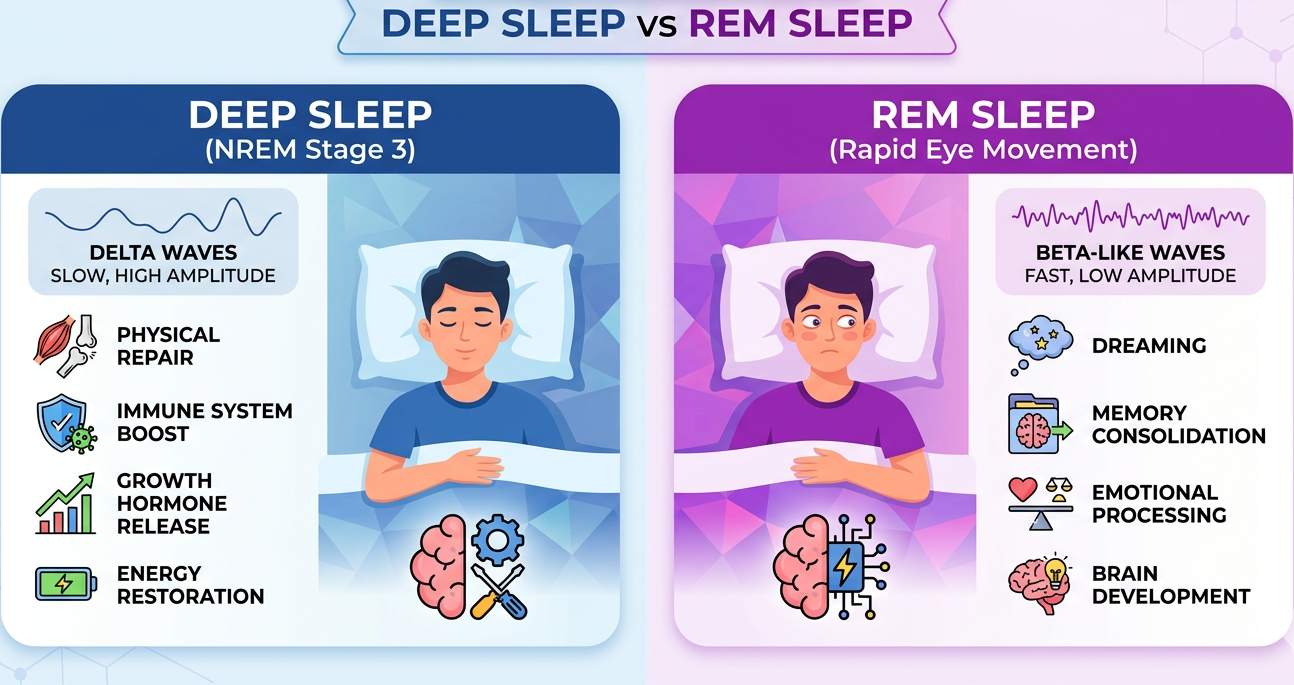
Stage 3: Deep Sleep
Stages 3 and 4, also referred to as the slow-wave sleep, is necessary in the physical regeneration and immunity.
During deep sleep:
- Blood pressure drops
- Muscles relax completely
- Tissue repair and growth takes place.
- Growth hormone is released
Children and athletes need deep sleep particularly in the sense that it facilitates physical development.
REM Sleep
The onset of REM sleep is after an average of 90 minutes of sleep.
During REM sleep:
- Brain activity increases
- Most dreaming occurs
- Eyes jerk to and fro with eyelids closed.
- The breathing becomes irregular.
- The muscles relax temporarily to avoid movement during dreams.
In memory consolidation, emotional processing, and learning, the REM sleep is important.
Why Sleep Cycles Matter
Sleep cycle disturbances can result in:
- Daytime fatigue
- Memory problems
- Mood disorders
- Reduced concentration
- Increased stress
Normal sleep cycles may be disrupted by such sleep disorders as insomnia and sleep apnea.
Sleep Cycle Disorders Treatment
Doctors may recommend:
- Sleep hygiene improvements
- Cognitive behavioral therapy.
- Correction of underlying medical disorders.
- Drugs in some instances.
FAQs
1. What should the average sleep cycle take?
About 90 minutes.
2. What is the number of sleep cycles per night?
Typically 4‑6 cycles.
3. Is REM sleep necessary?
Yes, it aids memory and emotional wellness.
4. What is the effect when deep sleeps is disturbed?
There is the possibility of physical recovery and immune functioning.
5. What can be done to get people to improve sleep cycles?
Regular sleeping routines and limiting the effect of screens could be useful.
Conclusion
The sleep patterns play a crucial role in keeping an individual physically and mentally healthy. REM sleep and deep sleep are complementary in function, although they have different functions in restoring the body and brain functionality. Maintaining adequate rest and safeguarding such cycles can be of great benefit to well-being.